> ## Documentation Index
> Fetch the complete documentation index at: https://www.presolve.com/docs/llms.txt
> Use this file to discover all available pages before exploring further.
# Prepare a resolution and hand it to accounting
> Record settlement terms as a draft, let accounting complete deposit routing, and understand editing after activation.
Open **Accounting → Resolutions**, or the matter's **Accounting → Resolutions**. Legal staff record the settlement terms. Accounting completes the financial setup and activates the resolution. The case-specific view supports the same handoff: accounting users with access to the matter and the required settlement and payment-processing permissions can select routing, activate, finalize, and close resolutions there.
Accounting's review establishes financial readiness. It is not a separate approval of the underlying legal settlement. Screenshots below use fictional local demonstration data; amounts and fee percentages are examples, not a firm policy.
## Legal: prepare the draft
1. Select **Add Resolution** and choose the case and resolution type.
2. Enter the amount and required dates. For **Back Fees**, the period start and end dates are optional; the settlement date is still required. Review the payor, attorney fee percentage, and displayed fee dollars.
3. Review **Case referral source** for the recorded source name and type. Set the source type in **Intake → Additional Details → Referral Source Type**. Attorney sources preselect **Has Referral Attorney**, including when no fee percentage is recorded. If a referral applies, check the referral attorney and fee details. Add supporting notes and documents through the appropriate matter records.
4. Save the resolution. A user with settlement permissions but without payment-processing authority creates a **Draft**, without selecting a deposit account.
5. Coordinate the handoff to the accounting user under your firm's task or workflow process.
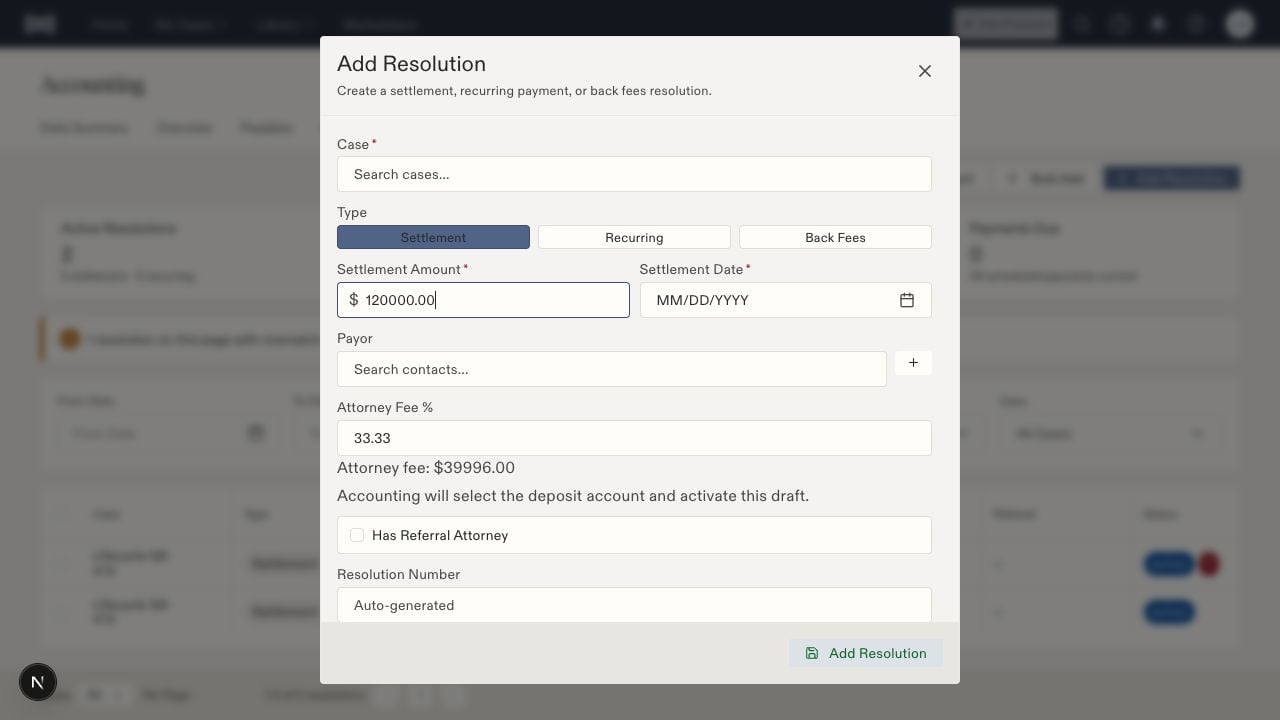 An accepted negotiation can also create a Draft resolution when that flow is configured. Review the draft's amount, fee/referral details, and source information before continuing. **Bulk Add** creates Draft resolutions for accounting to complete.
Draft creation does not start check creation. A Draft alone also does not change the resolution-based funding suggestion to Cash.
## Accounting: complete routing and activate
1. Open the resolution's **Edit** action.
2. Compare the amount, dates, payor, attorney fee dollars, and referral details with the source settlement information. Correct discrepancies before activation.
3. Select the appropriate **Deposit Account** for the firm, following its Operating/IOLTA policy. Use an available firm account; contact the integration owner if the correct account is missing.
4. Set **Status** to **Active** and select **Save Changes**. An initial activation without a routing account is rejected.
5. Verify the list shows the intended amount, deposit account, and Active status before linking incoming checks and proceeding with allocations.
An accepted negotiation can also create a Draft resolution when that flow is configured. Review the draft's amount, fee/referral details, and source information before continuing. **Bulk Add** creates Draft resolutions for accounting to complete.
Draft creation does not start check creation. A Draft alone also does not change the resolution-based funding suggestion to Cash.
## Accounting: complete routing and activate
1. Open the resolution's **Edit** action.
2. Compare the amount, dates, payor, attorney fee dollars, and referral details with the source settlement information. Correct discrepancies before activation.
3. Select the appropriate **Deposit Account** for the firm, following its Operating/IOLTA policy. Use an available firm account; contact the integration owner if the correct account is missing.
4. Set **Status** to **Active** and select **Save Changes**. An initial activation without a routing account is rejected.
5. Verify the list shows the intended amount, deposit account, and Active status before linking incoming checks and proceeding with allocations.
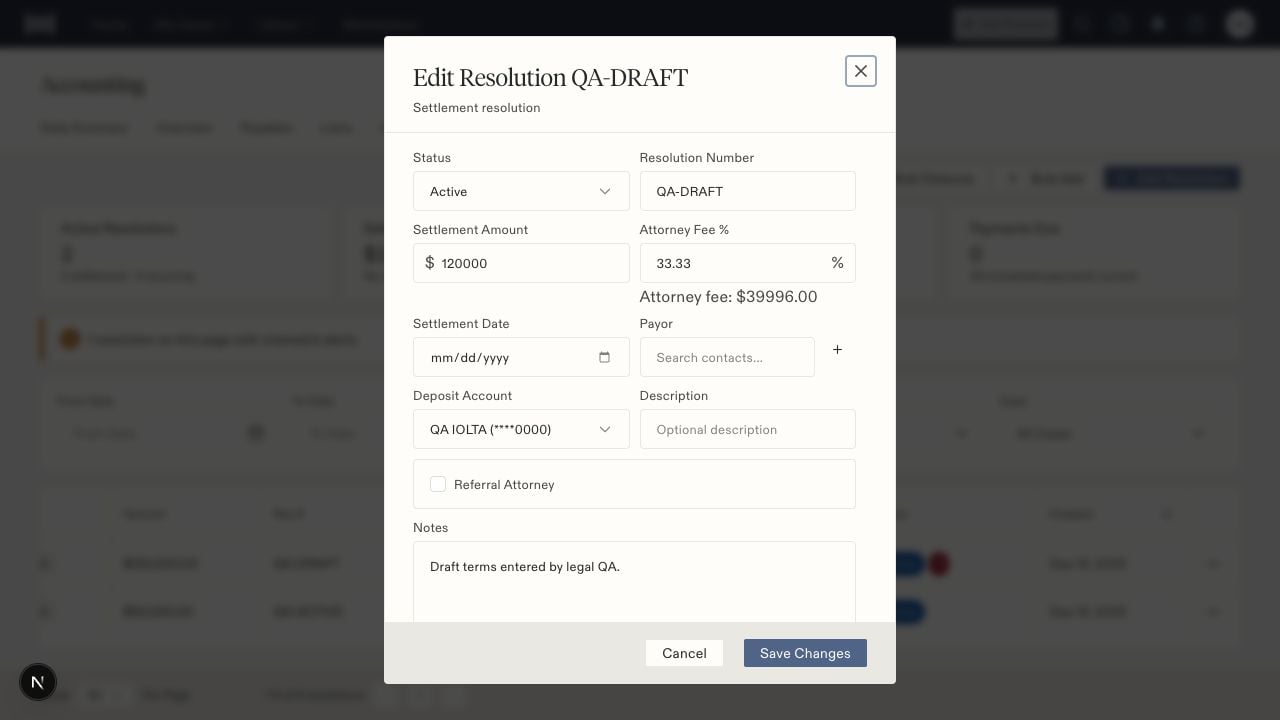 The **Resolution Number** is a reference label. Read **Status** to determine whether the resolution is Draft or Active; changing the number does not change the lifecycle state.
Activation does not itself deposit funds, transfer money, or post a settlement distribution to QuickBooks. Continue by [recording the incoming check and its allocations](/docs/help/accounting/checks), then reviewing the [disbursements](/docs/help/accounting/disbursements).
## After activation
Legal staff can continue editing the resolution number, description, and notes. Financial terms, fee/referral changes, deposit routing, and status changes require accounting authority in addition to the relevant settlement permission.
The **Resolution Number** is a reference label. Read **Status** to determine whether the resolution is Draft or Active; changing the number does not change the lifecycle state.
Activation does not itself deposit funds, transfer money, or post a settlement distribution to QuickBooks. Continue by [recording the incoming check and its allocations](/docs/help/accounting/checks), then reviewing the [disbursements](/docs/help/accounting/disbursements).
## After activation
Legal staff can continue editing the resolution number, description, and notes. Financial terms, fee/referral changes, deposit routing, and status changes require accounting authority in addition to the relevant settlement permission.
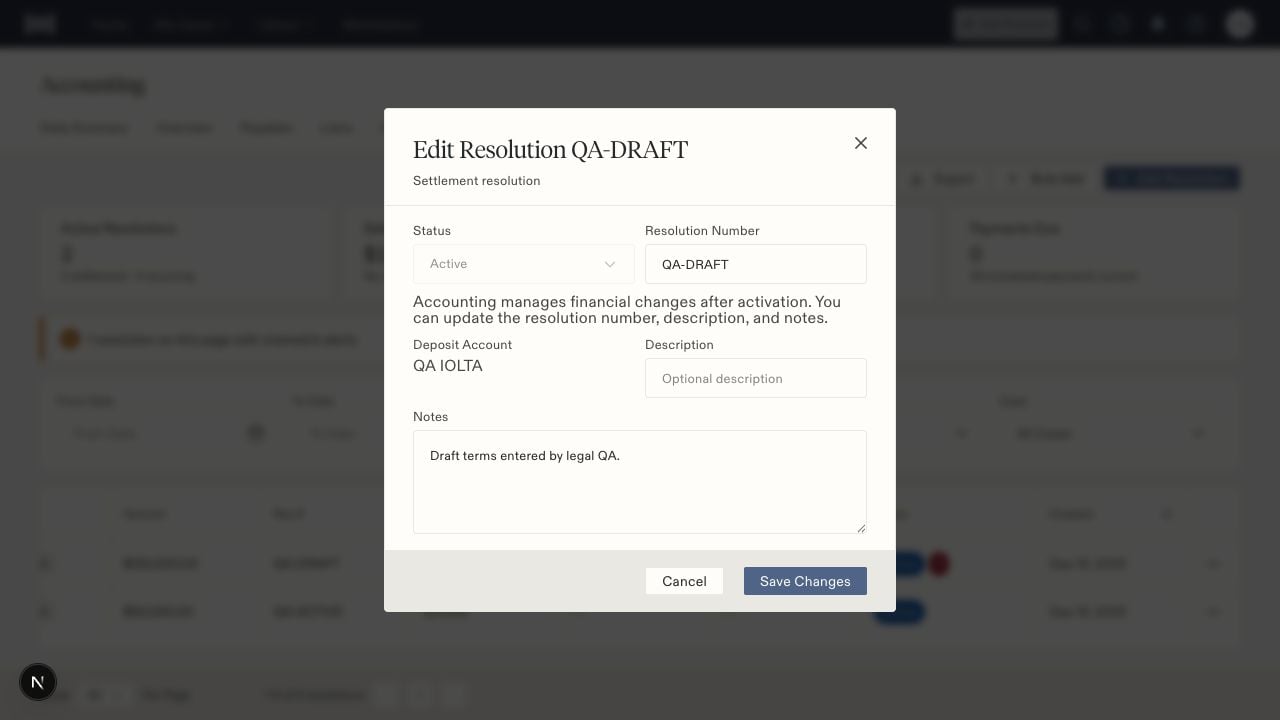 Accounting also owns finalization, closing, and voiding. Finalize an **Active** resolution before closing it; only **Finalized** resolutions can be closed. Review linked receipts, allocations, disbursements, and any mismatch messages before those actions. Bulk close requires every selected resolution to be Finalized and free of blocking mismatches; if any selected record fails, none are closed. Legal users can cancel an eligible unactivated draft through **Cancel Draft**.
If someone activates a draft while you are editing it, a save can ask you to reload. Reopen the current record and coordinate any financial correction with accounting.
Related: [The litigation-cost lifecycle](/docs/help/accounting/litigation-cost-lifecycle).
Accounting also owns finalization, closing, and voiding. Finalize an **Active** resolution before closing it; only **Finalized** resolutions can be closed. Review linked receipts, allocations, disbursements, and any mismatch messages before those actions. Bulk close requires every selected resolution to be Finalized and free of blocking mismatches; if any selected record fails, none are closed. Legal users can cancel an eligible unactivated draft through **Cancel Draft**.
If someone activates a draft while you are editing it, a save can ask you to reload. Reopen the current record and coordinate any financial correction with accounting.
Related: [The litigation-cost lifecycle](/docs/help/accounting/litigation-cost-lifecycle).