

Find the call on a case
- Open the intended Presolve organization and case.
- Select Records → Calls. Clear search and category filters if necessary.
- Compare the date, direction, and people, then open the call.
- Inspect Participants, Call Details, Recording, and Call Notes.
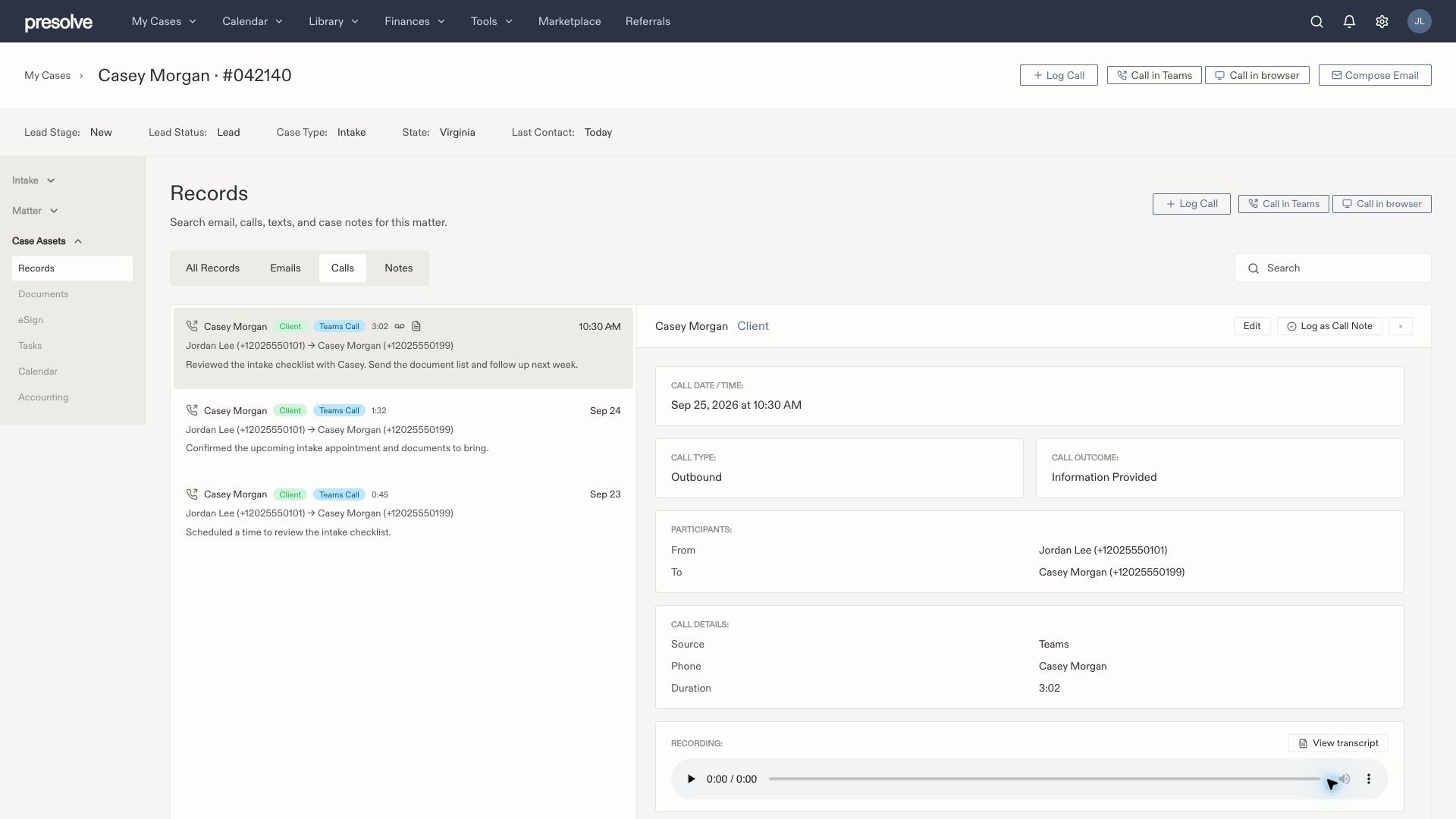
Open a call to see its participants and details. The demonstration workspace uses the expanded Records layout.
Which calls are imported?
Tracking is scoped to the Presolve organization. Presolve imports calls involving the organization’s verified or mapped users’ individual lines and explicitly selected shared lines. Other numbers are skipped before saving a call or fetching its recording. The Microsoft number inventory can contain more lines than Presolve tracks. A number visible in Add numbers is not proof that its calls are imported. See firm call tracking.How calls match to cases
Both inbound and outbound calls can be associated with a case. Presolve checks the other party’s phone number against clients and linked case contacts, including people such as insurance adjusters and medical providers. Starting a call from a case also supplies context for that conversation.
For example, an adjuster’s office number may appear on several matters. Presolve should not attach every call from that office to one client, or label everyone using that number as the client.
While using the browser dialer, expand Caller, case and role to choose or correct the case, contact, name, and role. Select Save call notes to retain the corrections. You can do this during or after the call, including after answering an unknown caller. See editing caller details.
Saved corrections apply to the individual call and survive later Teams imports. They do not update the contact directory or change other calls. If you are writing notes for a Teams-app call, review the same details in its New Call draft.
A call’s case cannot be changed or removed once a recording, transcript, case note, or follow-up task is linked, or while recording or transcription work is running. Those items stay with their case. You can still correct the caller’s name and role. For an incorrect case that is locked, see IT/support: correcting call details.
Resolve a call that needs a case match
Open Approvals → Pending → Calls needing review. Unresolved Teams and RingCX calls are grouped into one review item per day, using your firm’s timezone. The Approvals waiting count counts these daily items, not individual calls. Each item shows how many calls it contains; open it to review the calls inside. Existing unresolved calls are included automatically. The queue requires access to Approvals and permission to manage your firm’s integrations. If it is absent, ask your firm administrator. The same Teams calls also remain available under Settings → Integrations → Microsoft Teams Phone → Calls needing review. Attaching or dismissing a call resolves it in both places. The queue explains each call:- Inbound: caller → receiving line → employee.
- Outbound: employee → calling line → called number.
- No matching claim: Presolve did not find a case for the other party’s number.
- Multiple matching claims: more than one case matches the number, so a person must choose the correct case.
1
Open the day's review item
In Approvals, select Calls needing review for the call’s date. Search inside the item by caller, receiving line, or employee. Narrow by direction when the queue is large. The integration settings queue also has an employee filter. Select Refresh calls to reload it.
2
Check the conversation's context
Compare the time, duration, employee, and firm line. For a shared intake number, the receiving line helps distinguish the purpose of the call.
3
Select the correct case
Choose a suggested case or use Search for a claim. Check the case number as well as the name.
4
Attach or dismiss
Select Attach, then open that case’s Records to verify the result. Use Dismiss when the call should not be attached to a case. For multiple unwanted entries in the integration settings queue, select them and choose Dismiss selected. Select this page applies to the displayed page.
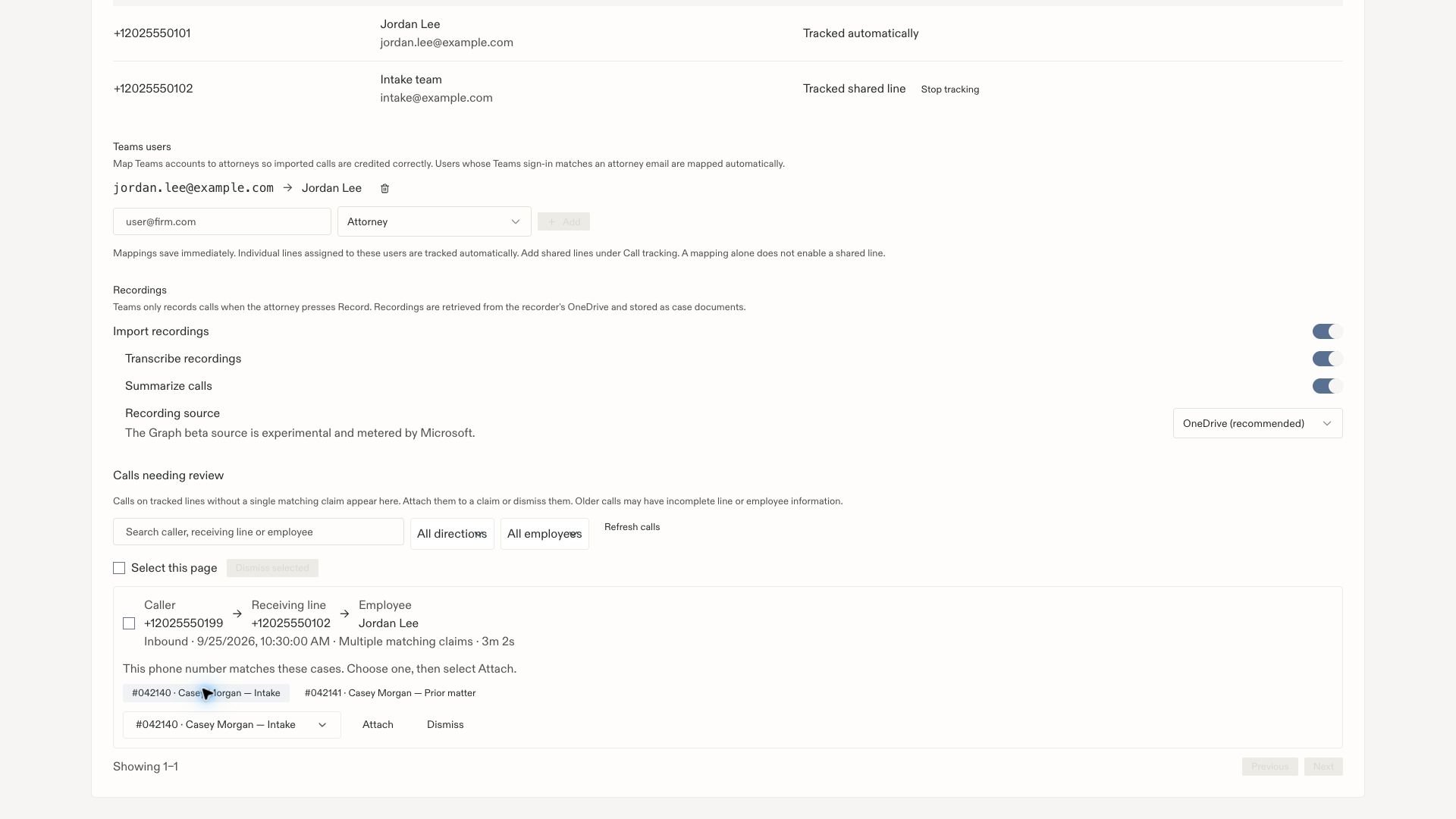
The queue identifies the caller, receiving line, employee, and candidate cases. Selecting a case enables Attach.
Find a recording or transcript
1
Confirm that a recording was created
Check the call in Teams first. Importing calls and saving notes do not start recording. The Presolve browser dialer also does not automatically record audio.
2
Open the call in Presolve
Go to the case’s Records → Calls and select the corresponding entry. Under Recording, use the player’s play, pause, and seek controls when an imported file is available.
3
Open an available transcript
Select View transcript when present. Transcription must be enabled and finish processing. Review the transcript against the recording before relying on names, numbers, or commitments.
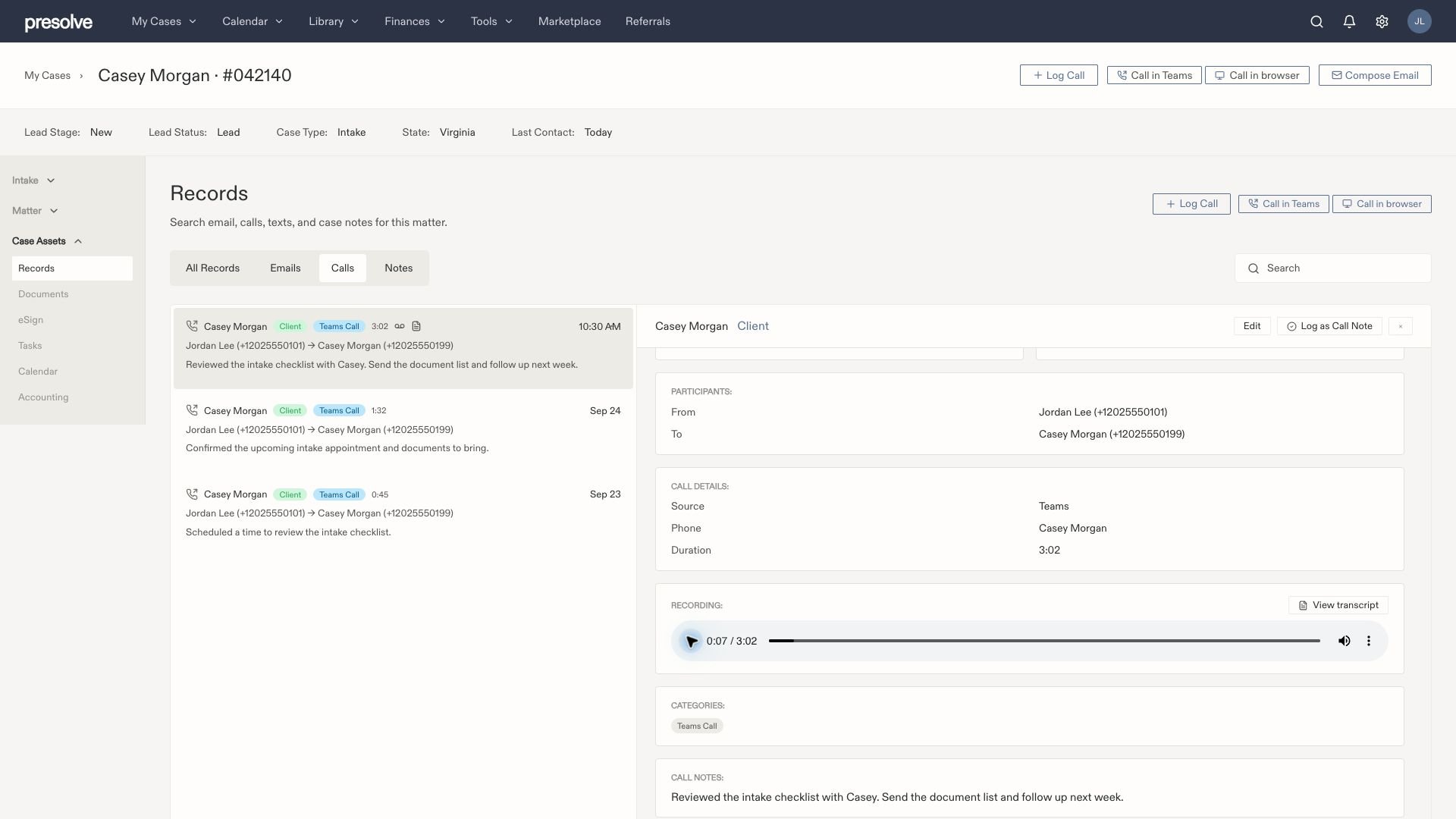
Scroll within the call details to Recording. Use the player or View transcript when available. This example uses silent sample audio.