Open a saved report from Tools → Reporting. Run it and review the filters, columns, and representative rows before exporting or sharing the result.

Download the current result

Select Export in the report builder. Wait for the export result, then open the downloaded file and check its headings, row count, dates, and amounts before sharing it. A download confirmation does not replace checking the file itself. Full Preview lets you inspect the table before exporting. Chart Download PNG controls are separate from exporting the underlying data. For a chart’s setup, see charts and summaries.

Schedule email delivery

  1. Save the report configuration you intend to distribute.
  2. Select Schedule.
  3. Review Status and Format. CSV is the initial format shown.
  4. Enter an intended recipient and select Add. Check the complete recipient list.
  5. Choose Daily, Weekly, or Monthly frequency and the corresponding day/time options.
  6. Check the timezone shown in the dialog. Use that timezone when interpreting the selected time.
  7. Select Create Schedule only when automatic delivery to those recipients is intended.
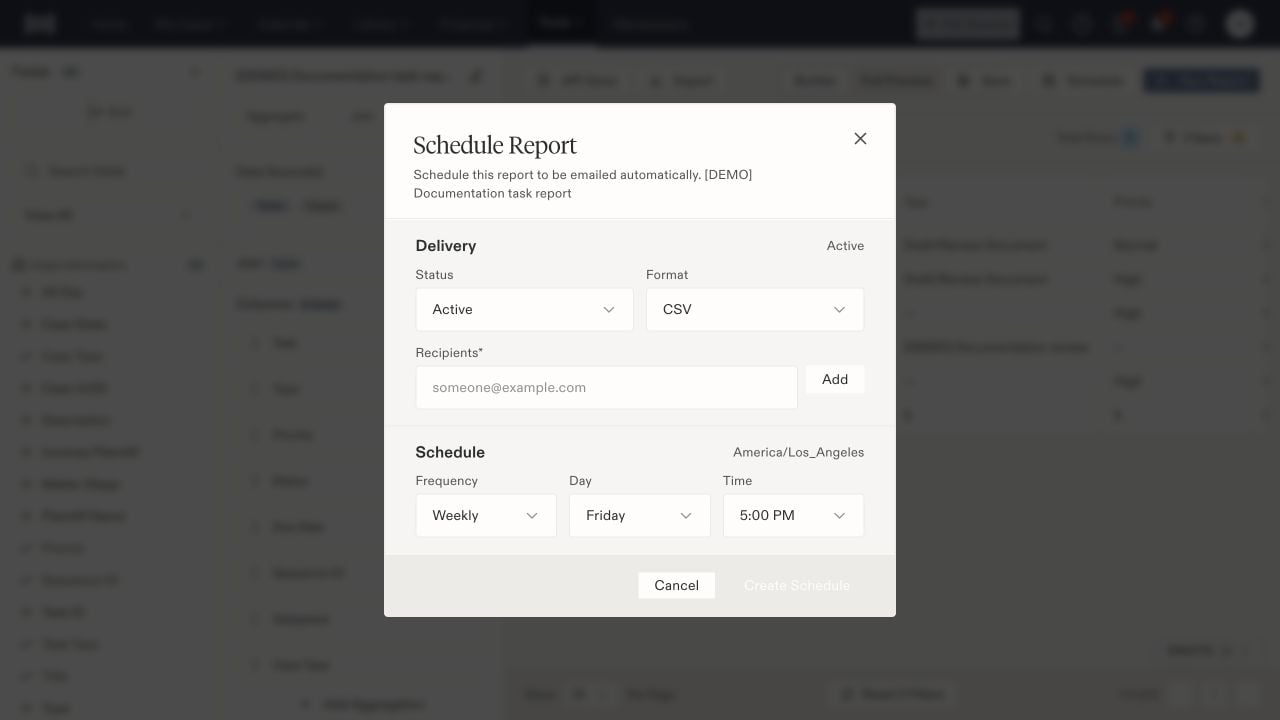
Schedule Report dialog with Active status, CSV format, empty recipients, weekly frequency, and displayed timezone.

Scheduled reports have their own delivery status, recipients, frequency, and timezone.

A schedule distributes report data automatically. Recheck its recipients and included columns when the report’s purpose changes. After the first scheduled delivery, confirm that the intended recipient received the expected file. If it is missing, review the schedule’s active state, timezone, and recipient list before creating another schedule.

Share with another system

The report workspace also links to API Docs for technical integration. Give an administrator or developer the reporting reference when another system needs report data. API credentials and individual report-access settings are separate from email scheduling; creating a schedule does not grant API access. For HQ integrations, confirm the key’s acting attorney and organization-scope setting as well as the report’s publication and sharing. A wider scope does not remove the saved status, date, or practice-area filters. See Report execution and Troubleshooting reports.